


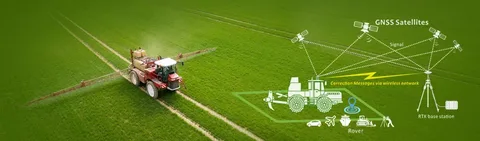
The rise of autonomous vehicles has transformed the way we think about transportation, safety, and mobility. At the heart of this revolution lies advanced navigation technology, with precision gps playing a critical role in ensuring vehicles can navigate safely and efficiently. In this article, we explore the significance of precision GPS in autonomous vehicles, its applications, and the challenges it faces.
Understanding Precision GPS
Precision GPS, also known as high-accuracy GPS or RTK (Real-Time Kinematic) GPS, provides location data with centimeter-level accuracy. Unlike standard GPS, which can have errors of several meters, precision GPS allows autonomous vehicles to determine their exact position on the road. This high level of accuracy is crucial for tasks such as lane-level navigation, obstacle avoidance, and seamless integration with other sensors like LiDAR and cameras.
Enhancing Safety in Autonomous Vehicles
One of the primary roles of precision GPS in autonomous vehicles is enhancing safety. Autonomous vehicles rely on a combination of sensors, but even small errors in positioning can lead to accidents. Precision GPS ensures that the vehicle’s software can accurately track its location relative to other vehicles, road markings, and surrounding infrastructure. This accuracy is vital for making split-second decisions, especially in complex urban environments.
Applications of Precision GPS in Autonomous Driving
Precision GPS supports several key functions in autonomous vehicles:
- Lane-Level Navigation: Allows the vehicle to stay precisely within its lane, even on winding roads.
- Adaptive Routing: Helps vehicles calculate optimal routes based on real-time traffic data.
- Collision Avoidance: Enhances the effectiveness of emergency maneuvers by providing exact location data.
- Fleet Management: Supports coordination of autonomous delivery vehicles or taxis with precise location tracking.
Challenges and Future Developments
Despite its advantages, precision GPS faces challenges such as signal loss in tunnels, urban canyons, or areas with heavy tree cover. To overcome these limitations, autonomous vehicles often integrate precision GPS with other sensors like LiDAR, radar, and computer vision systems. The future may also see improvements in satellite technology and algorithms that further enhance the reliability and coverage of high-accuracy GPS.
Conclusion
The role of precision GPS in autonomous vehicles cannot be overstated. From ensuring safety to enabling advanced navigation and fleet management, precision GPS is a foundational technology for self-driving cars. As autonomous vehicle technology continues to evolve, the integration of precision GPS with other sensing systems will be key to achieving fully reliable and safe autonomous transportation.
